The Sprayer That Bills by the Acre, and Only When It Saves You Money
5 min read
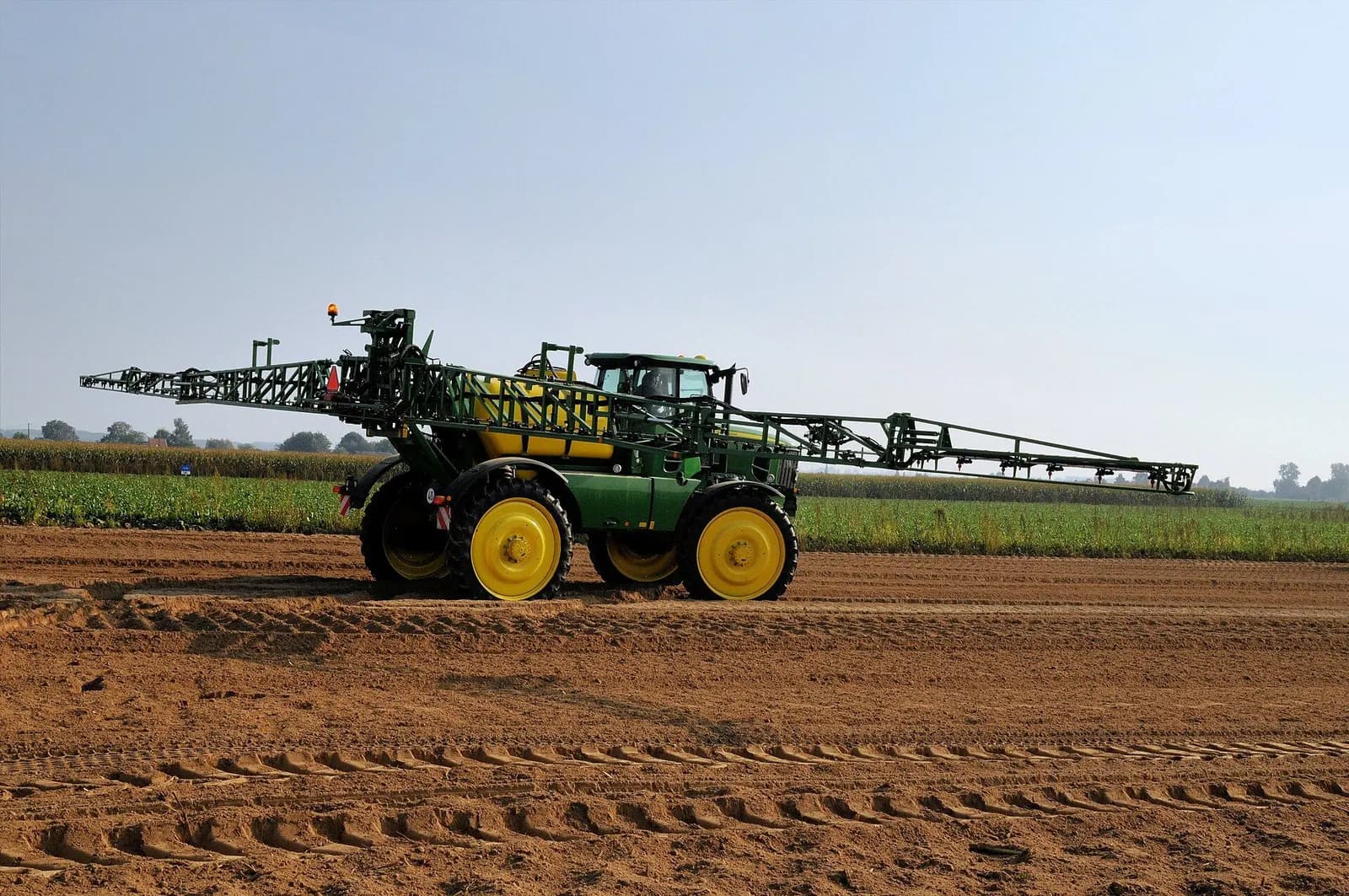

Picture a sprayer rolling across a soybean field in early summer. Cameras along the boom watch the ground, and most of the time nothing happens. The weeds are small and scattered, so the nozzles stay shut. Somewhere in the software, a counter is ticking, and what it counts is the whole story.
As of Deere's November 2025 release, the fee for its See & Spray technology was $1 per fallow acre or $5 per in-crop acre, charged only when the technology delivers measurable savings.1 Deere's Joshua Ladd put it this way: "If See & Spray doesn't save you money, you don't pay. It's that simple."1 So here is a machine that bills you for the herbicide it didn't spray. How did a piece of farm equipment end up with a meter, and is it the only one?
Thirty-six cameras and a big goal
On March 3, 2022, Deere launched See & Spray Ultimate as a factory option on model year 2023 sprayers built in Ankeny, Iowa.2 The boom was 120 feet wide and carried 36 cameras that scanned more than 2,100 square feet at once. Deere said that at 12 mph it could "reduce non-residual herbicide use by more than two-thirds."2 Supply was tiny, with Deere saying only "double-digit units" would be orderable later that year.2
That same spring, a trade publication reported a number that explains a lot. Deere's stated goal was for 10% of its revenue to be recurring by 2030, and its CFO, Ryan Campbell, named autonomy and a "sense-and-act" platform as major ways to get there.3 One analyst, Shane Thomas, estimated that a 10% mix would be worth roughly $5 billion to $6 billion once eight years of growth are counted.3
See & Spray was the first step on that path, and the same article said it may support a recurring-fee model.3 Thomas argued that software updates justify a continuing annual fee, "assuming it is priced fairly."3 The unspoken question in that last phrase is who decides what fair means.
A price that keeps changing shape
The answer, so far, is that it moves. In January 2024, Deere said its pricing varied by customer and that it was charging "$4 per acre in the test run with corn growers."4 By then, the company said the technology had covered 1 million acres and saved 8 million gallons of chemicals.4
By late 2025 the fee had become the $1 and $5 split, tied to savings.1 For 2026, Deere added an Unlimited Annual License for operations that spray a lot of acres, sitting alongside the pay-by-use option.5 Then in January 2026, AgNavigator reported that a Gen 2 version would replace the earlier Select, Premium and Ultimate options with one platform on model year 2027 sprayers. That report gave no dollar figures.5
If you were a buyer, your bill would depend heavily on which year you asked. Prices like these change, so anyone weighing one should check with a dealer.
What the farmer actually gets
The payoff is chemicals not bought. Deere reported that across about 5 million acres in 2025, customers cut non-residual herbicide use by roughly 50% on average, saving nearly 31 million gallons of herbicide mix.1 Those are the company's own numbers, so it helps to look at an independent one.
Iowa State University ran a demonstration on five soybean fields totaling 415 acres in Boone and Story counties. The average saving was 76%, though it ranged from 43.9% to 90.6% depending on the field. That was worth nearly $6,500, or $15.7 per acre.6 The authors were careful, though. They wrote that savings "were directly influenced by the initial weed pressure in the field" and that "Specific herbicide reduction levels are not guaranteed."6
That uncertainty helps explain why a savings-linked fee can make sense. If nobody can promise how much a field will save, charging only when savings show up shares the risk between the maker and the farmer. Whether the price itself is fair is a separate matter, and it is the question Thomas left hanging back in 2022.
Who holds the keys
A machine that bills by software raises an older question: who controls that software once you've paid for the tractor? Colorado's HB23-1011 was approved on April 25, 2023, and took effect on January 1, 2024. It requires agricultural equipment makers to give owners and independent repair shops the parts, software, tools and documentation needed to diagnose and fix equipment.7 Under the law, failing to do so is a deceptive trade practice.7
On January 15, 2025, the Federal Trade Commission and the attorneys general of Illinois and Minnesota sued Deere in federal court in Illinois. The complaint alleged that Deere's only fully functional repair software is available only to authorized dealers.8 FTC Chair Lina Khan said the action sought "to ensure that farmers across America are free to repair their own equipment."8
On July 8, 2026, the FTC and five states announced a settlement. Under it, Deere would give farmers and independent repairers, on fair and reasonable terms, the same repair tools it gives its dealers. That includes reading and clearing fault codes and technical manuals.9 The order runs 10 years and was submitted for court approval, which the release says is needed before it takes legal effect.9 If you farm with Deere equipment, it is worth checking whether the judge has signed it.
To be clear, this fight is about repair tools. Neither the Colorado law nor the settlement deals with how a company prices a feature like See & Spray.
The meter spreads
Deere isn't the only maker heading this way. On a November 2024 earnings call, AGCO said its OutRun autonomy retrofit would create "a recurring revenue stream where farmers will be billed for every active task hour." Farmers could pay as they go, buy an hourly bundle, or pay for unlimited use.10 AGCO's stated goal is fully autonomous solutions across the crop cycle by 2030.10 Deere, for its part, planned to sell its autonomous 8R tractor as a subscription, with details still to be worked out.3
Go back to that counter ticking in the cab. A tractor used to be something you bought once and then maintained. Increasingly, parts of it are something you rent by the acre, the hour or the year. Those charges recur, but they aren't the same each time, and annual licences renew on dates that are easy to lose track of.
That is the same problem a streaming bill or a software plan creates, just with a bigger machine attached. Subblink was built for the everyday version, keeping each subscription, its price and its renewal date in one place, but the habit carries over to a sprayer too: keep your own record of what you're charged and when. A meter you can't see is hard to argue with.
Sources (10)
- John Deere Customers Use See & Spray Technology Across Five Million Acres in 2025 (Deere news release, Nov 4, 2025) — Oklahoma Farm Report (reprint of Deere release)
- Deere Launches Green-on-Green See & Spray Ultimate for Corn, Soybeans, Cotton — Precision Farming Dealer
- Technology Corner: Autonomy to Play Significant Role in Deere's Target Recurring Revenue Goal — Precision Farming Dealer
- Deere CES 2024 coverage (See & Spray SaaS pricing, $4 per acre test run) — Farm Equipment
- John Deere reveals See & Spray Gen 2, updates for model year 2027 sprayers — AgNavigator
- Precision Spraying Technology (field-scale demonstration of See & Spray Ultimate) — Iowa State University Extension and Outreach
- HB23-1011 Consumer Right To Repair Agricultural Equipment — Colorado General Assembly
- FTC, States Sue Deere & Company to Protect Farmers from Unfair Corporate Tactics, High Repair Costs — Federal Trade Commission
- FTC, States Secure Settlement with Deere & Company, Advancing Farmers' Right to Repair — Federal Trade Commission
- AGCO Focuses on Precision Business Growth and Innovation in November Earnings Call — Precision Farming Dealer
Try Subblink free.
Add your subscriptions and see what you spend each month. On a paid plan, Subblink can scan your Gmail and find them for you. Email scanning works with Gmail only for now.
Start freeFree for unlimited subscriptions. No credit card.